Provider model routes
minimax/h3-max/text-to-video and minimax/h3-max/image-to-video.
Step 1
h3_live_xxx
| Name | Prefix | Status | Use | Revoke |
|---|---|---|---|---|
| No key loaded yet. | ||||
Step 2
Step 3
{ "status": "idle" }
Step 4
Plain answer
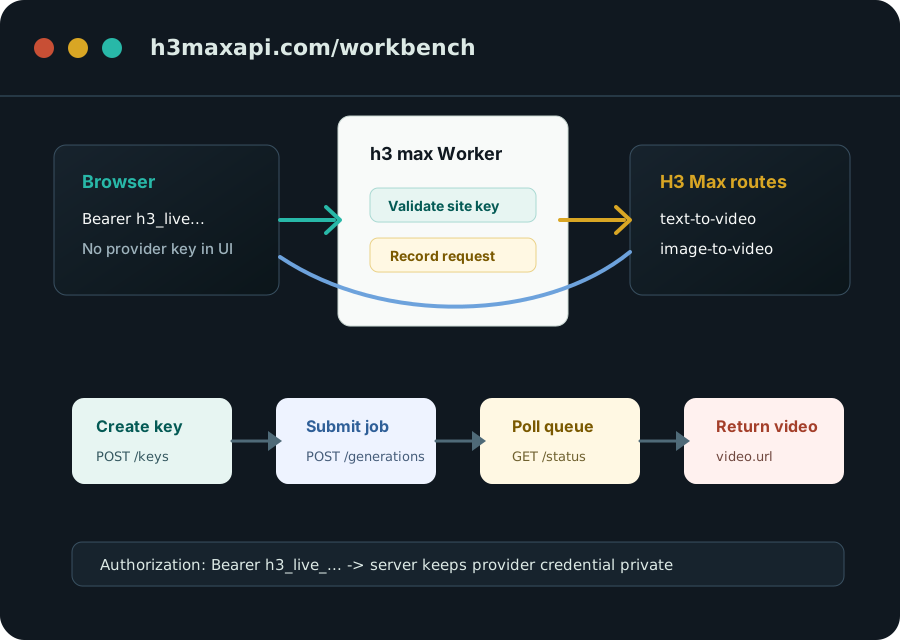
h3 max is a developer-facing API gateway for H3 Max video generation. Instead of placing a provider credential in client code, h3 max issues a site key that starts with h3_live_, validates each request at the edge, and then submits approved jobs to H3 Max text-to-video or image-to-video routes from the server. The goal is a small, practical bridge between model documentation and a real integration test: one page for creating a key, sending a prompt, checking queue state, and copying the exact request shape your backend can use.
H3 Max is presented by fal as a post-trained variant of MiniMax H3 for higher-quality video generation. MiniMax H3 itself is a multimodal model family described by MiniMax as supporting text, image, video, and audio context with video output that can include synchronized stereo audio. This site keeps those source boundaries visible. It does not claim to be the model creator, it does not expose upstream provider credentials, and it does not treat open-weight MiniMax H3 references as the same thing as the hosted H3 Max API routes. For teams evaluating the h3 max api, the useful first step is to validate the request contract, queue behavior, resolution and duration choices, safety settings, and result payload before building billing, teams, or automation around it.
API surface
The browser only sees site-issued keys. The Worker hashes those keys, stores the key ledger in D1, and sends provider requests from the server when generation is enabled.
POST /api/h3-max/keys
GET /api/h3-max/keys
PATCH /api/h3-max/keys/:id
POST /api/h3-max/keys/:id/revoke
GET /api/h3-max/channels
POST /api/h3-max/channels
GET /api/h3-max/clips
POST /api/h3-max/clips
POST /api/h3-max/clip-shares
GET /api/h3-max/clip-shares/{id}
GET /api/h3-max/chat-messages
POST /api/h3-max/chat-messages
GET /api/h3-max/creator-applications
POST /api/h3-max/creator-applications
POST /v1/h3-max/generations
GET /v1/h3-max/generations/:id
Current request facts
minimax/h3-max/text-to-video and minimax/h3-max/image-to-video.
prompt, duration, resolution, safety_checker, and prompt_expansion_mode.
Use 480P for quick checks and 768P when visual detail is part of acceptance.
Text-to-video accepts ratios such as 16:9, 9:16, and 1:1; image requests should respect the source image shape.
On September 4, 2026, fal lists launch rates of $0.0125/sec at 480P and $0.02/sec at 768P, with the listed discount ending September 7, 2026.
Fit check
Teams that need a fast server-side request path, a clean key boundary, queue status, and a shareable h3 max api integration example before building a larger video workflow.
Teams that need full account systems, usage billing, prompt libraries, team roles, or custom fine-tuning in the first release.
Run a small prompt set through the h3 max api, record accepted seconds, check safety outcomes, and confirm result payloads before automating batch jobs. That proof keeps product teams focused on measurable clip quality, predictable cost, and the exact API response their app will store.
Research pages
These source-backed inner pages use fal official material and independent benchmark sources for pricing, API fields, model comparisons, and video examples.
Launch rates, list rates, reference-token caveats, and sample totals.
CalculatorEstimate generated video cost by seconds, route family, and resolution.
BudgetPlan prompt batches with Turbo-first and standard review passes.
TurboWhen to use the lower-cost H3 Max Turbo routes and fields.
Turbo priceTurbo launch rates, list rates, and standard H3 Max comparison.
Route guidePrompt, duration, resolution, aspect ratio, queue, and result notes.
ExamplesOfficial fal sample videos for text, image, reference, and Turbo routes.
ComparisonSpeed, price, route coverage, and higher-resolution H3 tradeoffs.
VideoA video-output comparison for FPS, duration, resolution, and references.
ComparisonCost, tiers, API fields, audio, and independent leaderboard context.
Model lineageFal route families, FLUX 3 controls, and benchmark context.
API choiceChoose between lower-cost H3 Max clips and FLUX 3 keyframe workflows.
FAQ
The h3 max api is a key-first gateway for H3 Max text-to-video and image-to-video generation routes. It issues site keys, validates requests, keeps the provider key on the server, and returns queue or result state.
No. Browser examples use a site-issued h3_live key. The Worker keeps the provider key server-side and submits validated requests from there.
This workbench covers fal's minimax/h3-max/text-to-video and minimax/h3-max/image-to-video routes, with duration, resolution, prompt expansion, aspect ratio, and image URL fields where those fields apply.
No. MiniMax H3 is the underlying model family from MiniMax. H3 Max is presented by fal as a post-trained hosted route for H3 Max video generation.
Source-backed
Source notes collect the fal API references, fal launch notes, MiniMax H3 materials, and community checkpoints used to shape this homepage.
Open source notes